Local search is one of the most powerful ways for photographers to attract new clients. Every day, couples, families, and parents search Google looking for a wedding photographer, senior portrait photographer, or family photographer in their city. If your website is not showing up for those searches, you are invisible to clients who are already ready to book.
This guide covers the basics of local SEO for photographers: the core ranking factors, how Google evaluates your site, and what a strong foundation looks like. For the full strategy, including content, technical SEO, authority, and AI search, see the complete SEO for Photographers guide.
Why Local SEO Matters for Photographers
When someone searches for a photographer, they almost always include a location, or Google fills it in automatically. Searches like Nashville wedding photographer, Austin senior portrait photographer, or family photographer near me are happening every single day in every city across the country.
Local SEO helps your photography website appear for those searches and reach people who are actively looking to book. Unlike social media, local search traffic comes from people with real intent. They are not scrolling passively, they are ready to hire a photographer.
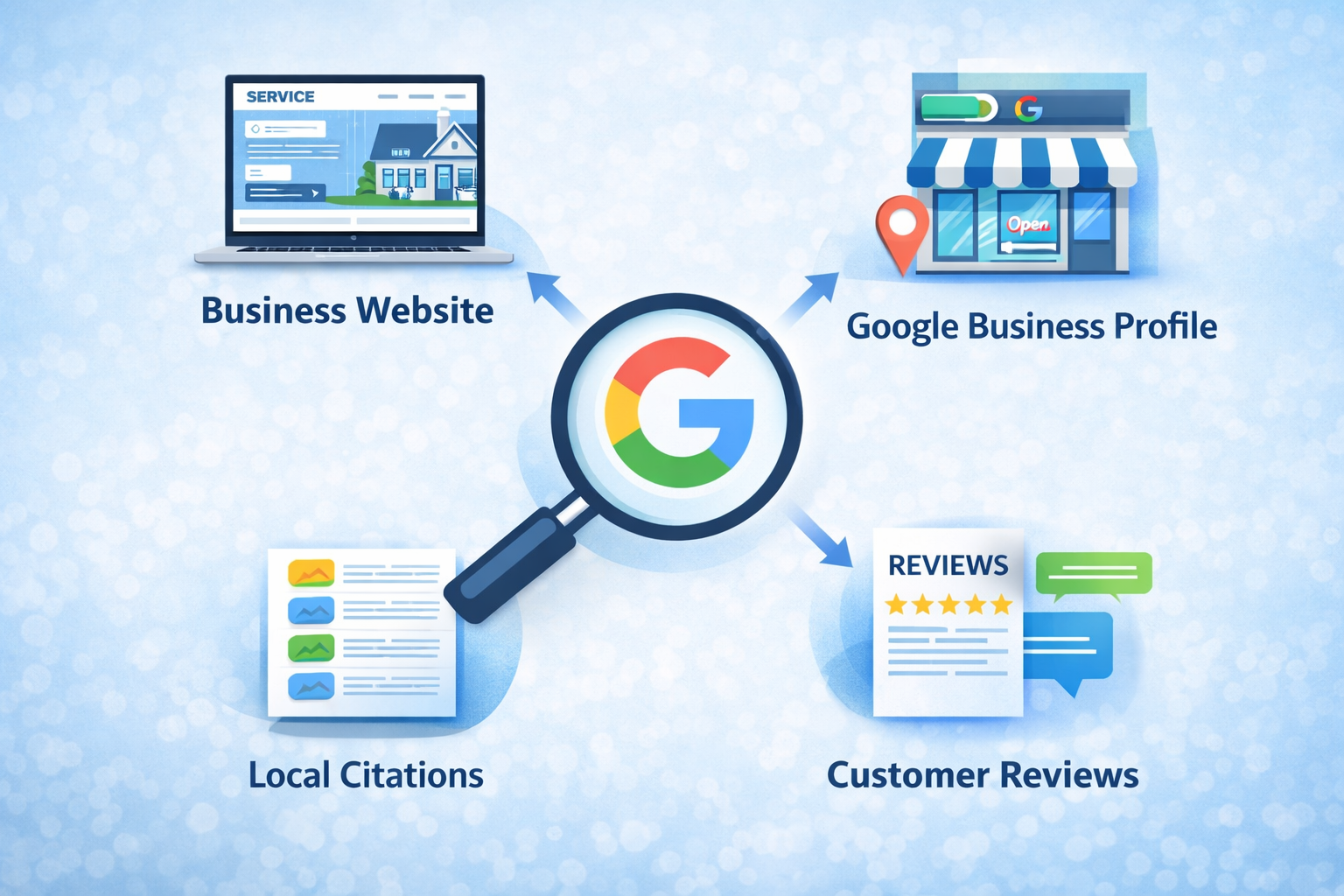
Key signals that influence local search visibility for photographers:
- Dedicated service pages for each photography specialty
- Clear location signals tied to your city or region
- An optimized Google Business Profile
- Consistent business name, address, and phone number across the web
- Client reviews that build credibility with Google
This type of search traffic is the most valuable kind. It comes from people who are already looking for exactly what you offer, ready to hire.
How Google Understands Your Photography Website
Google’s goal is to deliver the most relevant result for every search. When someone searches for a photographer in their city, Google evaluates multiple signals to decide which websites to show.
Google is trying to answer four questions about your site:
- What type of photography do you offer
- Where are you located and what areas do you serve
- Is your website credible and trustworthy
- Does your content demonstrate real expertise
The clearer your website answers those questions, the more confidently Google will rank you for the searches that matter. Most photography websites fail on at least two of these. Either the location signals are weak, or there are no dedicated service pages for Google to evaluate.
Building a Website Structure That Supports Local SEO
Most photography websites have a homepage, a gallery, and a contact page. That structure looks fine visually but gives Google almost nothing to rank. Strong photography websites have dedicated pages for each service, pages that Google can read, understand, and match to specific searches.
Examples of service pages every photographer should consider:
- Wedding photography
- Senior portrait photography
- Family photography
- Engagement sessions
- Headshots and personal branding
Each page should focus on one specialty, describe your approach clearly, and include the location you serve. This structure is what allows Google to match your pages with specific searches from real clients. For the full breakdown of how a photography site should be structured, see the SEO for Photographers guide.

Location Signals: How Google Knows Where You Work
For local SEO to work, Google needs to clearly understand where you are based and what areas you serve. This information needs to appear consistently across multiple places.
Your website should reference your city naturally throughout your service pages and homepage. Your Google Business Profile confirms your location and provides Google with additional trust signals. Directory listings and citations across the web reinforce that same information.
One of the most important, and most overlooked, factors in local SEO is NAP consistency. NAP stands for Name, Address, and Phone Number. When your business information is listed differently across directories, Google loses confidence in your location data. Your name, address, and phone number should be identical everywhere it appears online: your website, Google Business Profile, Yelp, wedding directories, and any other listing site.
When multiple sources consistently confirm the same location and service information, Google becomes confident enough to show your site in local results.
The Role of Google Business Profile for Photographers
Your Google Business Profile is one of the most important local SEO assets you have. It controls how your photography business appears in Google Maps and in the local pack, the map based results that show above traditional search listings and capture a significant share of clicks.
A complete profile includes your business name, location, phone number, website, hours, and specialties. But a complete profile is just the starting point.
What separates a well-optimized Google Business Profile from a basic one:
- A detailed business description that includes your primary photography specialties and city
- All relevant service categories selected
- Regular photo updates showing your actual work
- Consistent review collection over time
- Responses to every review, positive and negative
- Google Posts used to share updates, sessions, and availability
Client reviews on your profile signal credibility to both Google and potential clients who are comparing photographers. The volume of reviews, the recency of reviews, and whether you respond to them all factor into how Google ranks your profile in local results.

Photographers who actively maintain their profile and collect consistent reviews gain a meaningful advantage in local search visibility over those who set it up and never touch it again.
Citations and Directory Listings for Photographers
Citations are any online mention of your business name, address, and phone number. They appear on directories like Yelp, The Knot, WeddingWire, Thumbtack, and local business directories. Each consistent citation strengthens Google’s confidence in your location and legitimacy.
For photographers, the most valuable citations come from wedding and photography specific directories because they are highly relevant to your niche. General business directories like Google, Yelp, and the Better Business Bureau also carry strong authority.
The key is consistency. If your studio name is listed as “Smith Photography” on your website but “Smith Photography Studio LLC” on a directory, that inconsistency can dilute your local SEO signals. Audit your listings regularly and correct any discrepancies.
Content That Builds Long-Term Local Authority
Blog content helps photographers demonstrate expertise and capture searches that service pages alone cannot rank for. Educational articles, location guides, and planning content allow your site to show up for the questions your ideal clients are already searching.
Examples of content that works well for local photographer SEO:
- What to wear for family photos in [city]
- Best locations for senior portraits in [city]
- How far in advance to book a wedding photographer in [city]
- What is included in a wedding photography collection
- [Venue name] wedding photography, real session recaps
- Best parks and outdoor locations for family photos in [city]
Notice that location is woven into almost every content idea. That is intentional. The more your content references specific cities, venues, and neighborhoods, the stronger your local relevance signals become over time.
Each article adds topical authority to your site and creates additional entry points for potential clients to find you through search. Over time, a library of locally focused blog posts becomes one of your most powerful long-term SEO assets.
Internal Linking: The Structure Google Follows
Internal links connect your pages together and help Google understand the relationship between your content. When a blog post about senior portrait locations links to your senior portrait service page, Google follows that connection and strengthens the authority of that page.
For local SEO specifically, internal linking helps distribute the authority of your strongest pages, usually your homepage, down to your individual service pages. Every service page should be reachable from your homepage and from relevant blog content.
A well-linked photography website is easier for Google to crawl, easier to rank, and more likely to surface multiple pages in search results over time.
Building Long-Term Local SEO Strength as a Photographer
Local SEO is not a one-time fix. It is a foundation you build over time, and once it is built correctly, it keeps working for you month after month.
The photographers who rank consistently have these things in place:
- A clear site structure with dedicated service pages targeting specific searches
- Strong location signals across their site and Google Business Profile
- Consistent NAP information across all directories and listings
- Consistent client reviews building over time
- Blog content that targets real local search queries
- Internal links connecting related pages throughout the site
Getting all of these pieces in place, and the technical SEO, content, and AI search work that goes beyond the basics covered here, is exactly what the SEO for Photographers program builds for you.

Local SEO FAQ for Photographers
How long does local SEO take for photographers?
Most photographers begin seeing movement in local search rankings within 3 to 6 months of implementing a solid SEO foundation. The timeline depends on your market size, how competitive your city is, and how much content and authority your site already has. Smaller or mid-size markets often move faster. Highly competitive cities like New York or Los Angeles take longer.
Do I need a physical studio address to rank locally?
No. Many photographers operate without a commercial studio and still rank well locally. What matters is that your Google Business Profile and website consistently reference the city or region you serve. If you work out of your home and prefer not to list your address publicly, Google allows service-area businesses to hide their address while still appearing in local results.
How important are Google reviews for local SEO?
Very important. Reviews are one of the strongest signals Google uses to rank businesses in local results. The number of reviews, the average rating, the recency of reviews, and whether the business responds all factor into your local ranking. Photographers who consistently collect reviews after each session have a significant advantage over those who do not.
Ready to Rank Your Photography Website on Google?
This guide covers the fundamentals of local SEO. For the complete strategy, technical SEO, content and topical authority, internal linking, and AI search optimization, all built specifically for photographers, see the full SEO for Photographers page.
If your photography website is not showing up on Google the way it should, explore the complete SEO for Photographers program.